

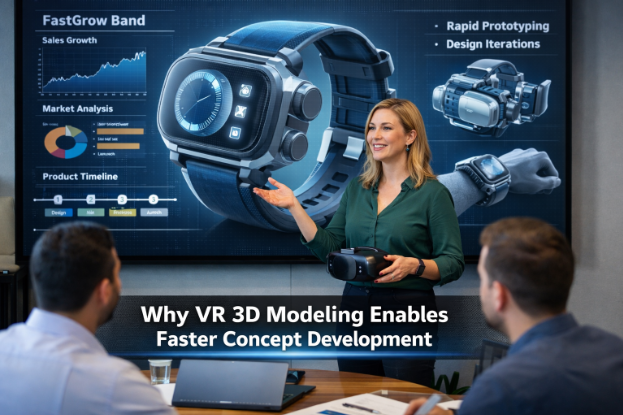

Concept development remains the backbone of any successful design project. This applies to any design field, which may include architecture, product design, engineering, or virtual environments.
The rate at which concepts transition from development to testing and validation has implications for innovation timelines. This process, which was previously slowed down by design limitations and lack of immediate feedback, has been reconstructed by VR 3D modeling.
By enabling the designer to create and explore their ideas within the virtual environment, the process of designing in VR takes away the usual barriers that could delay the conceptual stages of the process. This translates to quick idea development, distinct evaluation, and strong direction initially.
The Need for Speed in Concept Development
The beginning of the design process is a very exploratory process. Different designs are tested, and designs that aren’t so great are eliminated. In a typical process, every change can require a new render, export, or review, among other things, and this takes the process a step back.
VR 3D modeling offers a more fluid process by enabling the generation, viewing, and modification of concepts in real-time. This aspect ensures that the level of creative momentum remains high while allowing more concepts to be investigated within the same period.
One of the largest sources of delay in the development of concepts is the presence of uncertainty. It may take designers some time to visualize how the concept will look and feel when it is being viewed on the screen.
Immersive environments take away the need for guesswork. The designer will get to experience their concepts at actual scale immediately after their design. The designer will immediately be able to decide whether to continue with or shift a concept through real-time visualization.
Enabling Rapid Iteration
The iteration phase plays an important role in the concept development phase, though current solutions tend to break the flow as there is a constant need to shift from the modeling or rendering phase to the review phase.
In the case of VR 3D modeling, modifications can be done in the same virtual world. The designer can view the result immediately, thereby cutting down the cycle time considerably.
Intuitive Interaction Upgradepour la Creativity Flow
Common design software has complex workflows that make experimentation cumbersome. VR spaces involve natural motions, such as reaching out.
Designers are then able to manipulate concepts through gestures instead of through a series of menus. This allows the creativity process to occur at a faster rate, with concepts developing naturally.
The Early Detection of Weak Concepts
One of the great benefits of an immersive workflow is the rapid identification of ineffective ideas. Often, an idea that looks great on a screen doesn’t feel right in an immersive environment.
In contrast, problems in reality become apparent only over time in virtual reality. The designer is able to examine proportions, flow, and usability earlier and save time from building concepts that do not go forward.
Improved Collaboration During Early Ideation
Sometimes, the development of a concept may need the involvement of designers, engineers, and key stakeholders. There may be delays if alignment is not achieved here.
Immersive environments provide an instant understanding of ideas. Teams can also use these environments to explore ideas collectively, as they can view changes visually. Many companies currently make use of professional 3D modeling services to guarantee that immersive ideas are precise.
Minimizing Dependence upon Early Physical Prototypes
Construction of physical models involves high costs and takes time. However, with the use of VR-based systems, one can check the validity of designs before applying the fabrication process.
This saves time and resources by not having to depend so much on the old physical models. Concept development can be carried out more quickly and with greater freedom.
Promoting Agile and Iterative Design Approaches
Contemporary design teams increasingly apply agile methods that place significant emphasis on rapid testing and improvement. The VR concept development process seamlessly integrates with this strategy.
Multiple ideas can be explored, evaluated, and validated during a single session by the designers. This enables projects to adjust rapidly according to the feedback or changing needs without having to re-initiate the concept phase.
The Extension of the Value of 3D Modeling Services
With the increased usage of immersive flows, 3D model-related services prove vital in enabling rapid conceptualization. These services assist in sustaining model performance, accuracy, and scalability in VR.
Handle technical optimization. By taking care of technical optimization, designers can devote themselves exclusively to the creative process, thus speeding up the developmental process in the initial stage.
Constructing Confidence Before Proceeding
Fast concept development means more than just speed. Fast concept development means certainty. The quicker teams understand concepts, the less they question them.
Immersive concept exploration enables the development of confidence in concepts by experiencing instead of imagining. Decisions come from clarity, not assumptions.
Conclusion
VR 3D modeling helps to develop a concept quickly, without any uncertainties, which saves a lot of iteration time. Designers can immediately check if their concept is correct or not, which helps to avoid errors in understanding. They have to concentrate on developing the correct concept.
When aided with quality 3D modeling solutions, the immersive workflow becomes even more efficient and scalable. As design cycles continue to shrink and demands continue to escalate, the use of VR solutions for concept development is anything but an innovation. It is, in fact, an effective tool that assists in racing from an idea to a direction with ease and confidence